From the lodge, on a clear morning, they float.
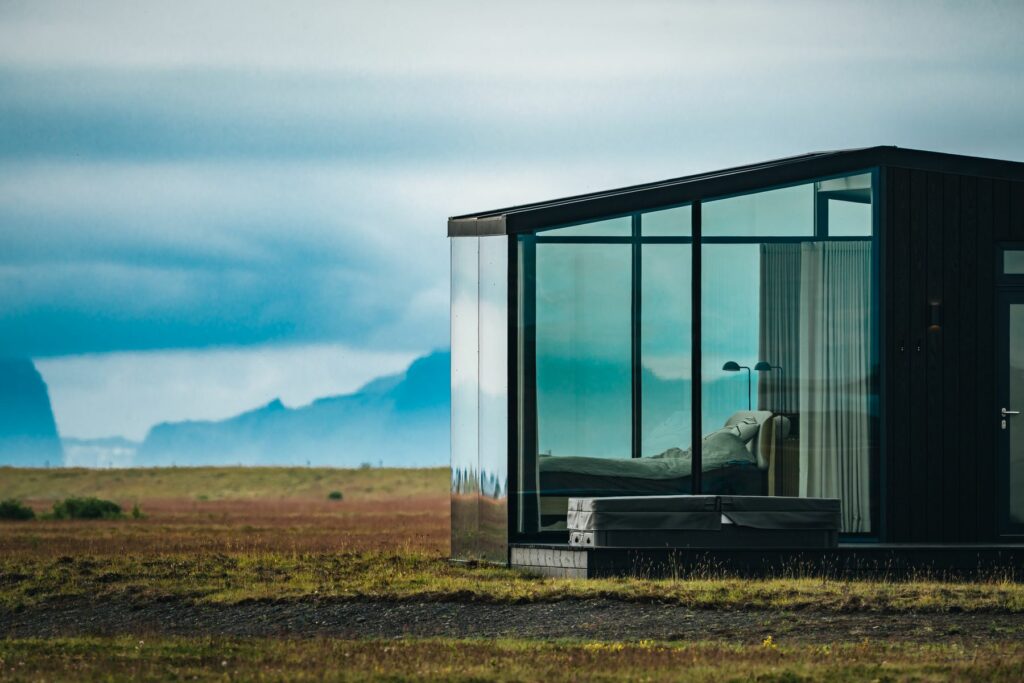
You see them first from the bed, through the glass: a row of dark shapes on the southern horizon, sitting on a silver line of ocean. Some mornings they are sharp enough to count. Others they dissolve into sea mist and seem to drift away altogether. By evening, with the sun low over the Atlantic, they turn black against a sky of copper and rose.
These are the Westman Islands, Vestmannaeyjar in Icelandic. Fifteen islands and some thirty rocks and skerries, born from the same volcanic system that built the South Coast. Only one of them, Heimaey, is inhabited. And from Harmony Seljalandsfoss, the ferry that takes you there leaves barely half an hour away.
Most guests spend their stay looking at the islands. The most curious ones go and stand on them.
The Islands You Can See From Your Lodge
Few places to stay in Iceland offer a view like the one from the lodges. To the north, the Eyjafjallajökull glacier. To the west, Seljalandsfoss falling from its cliff. And to the south, across the flat green plain of Landeyjar and a band of black sand, the Westman Islands rising out of the North Atlantic.
It is a view that changes by the hour. In summer the islands glow green in the late evening light. In winter they wear a thin crust of snow and catch the last pink of the afternoon. On some winter nights, the aurora rises above them, and the whole southern sky becomes part of the room.
Sooner or later, almost everyone asks the same question: can we go there? The answer is yes, and it is one of the most rewarding day trips you can take from a luxury lodge in Iceland.
How to Reach the Westman Islands From Harmony
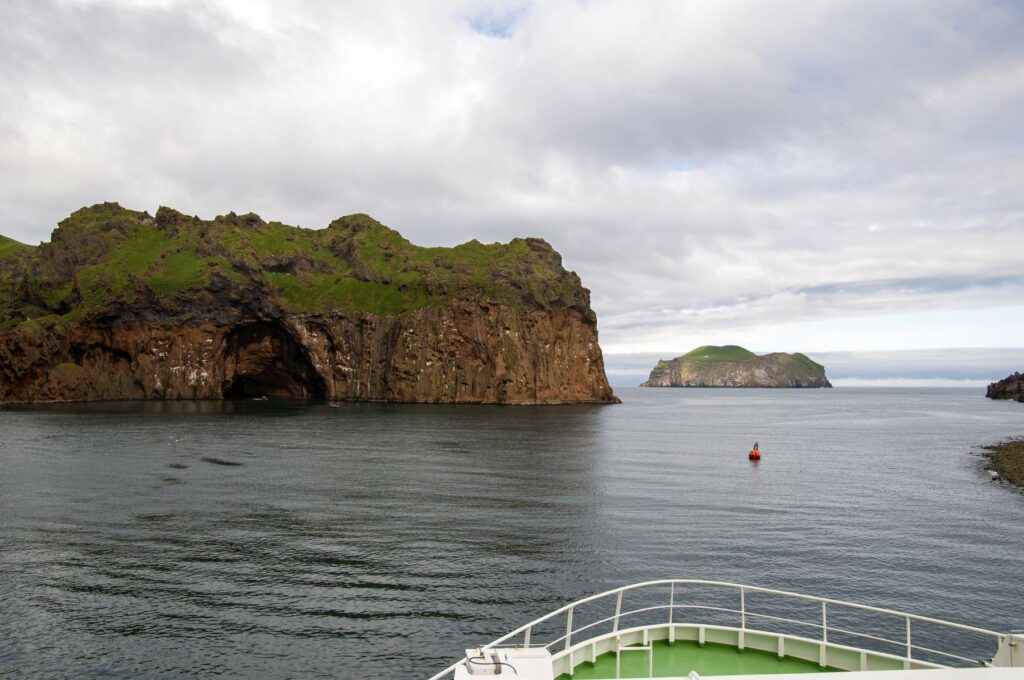
The Herjólfur ferry connects the mainland to Heimaey. Its main harbour, Landeyjahöfn, sits on the black sand coast directly south of the lodges, around half an hour’s drive away. From there, the crossing takes about thirty five to forty minutes.
This is what makes Harmony such a natural base. Travellers staying in Reykjavík face a long drive before they even reach the harbour. From a Seljalandsfoss accommodation, you can have breakfast facing the glacier, drive to the coast and be walking the streets of Heimaey before mid morning.
Practical tips for the ferry
- Book your tickets online in advance, especially in summer, and above all if you want to take a car.
- You do not need a car on Heimaey. Most sights are within walking distance of the harbour, and local taxis and guided tours cover the rest. Leaving the car at Landeyjahöfn makes the day simpler and cheaper.
- The North Atlantic decides the timetable. In rough weather, especially in winter, the ferry may sail from Þorlákshöfn instead, a crossing of around two hours and forty five minutes, or later in the day. Herjólfur informs passengers with a booking by text or email, so check your messages on the morning of your trip.
- If you are prone to seasickness, sit in the middle of the boat and keep your eyes on the horizon. On a calm day the crossing is pure pleasure.
Keep an eye on the water: whales and orcas
The sea around the Westman Islands is rich in herring, and the whales know it. In summer, orcas are regularly seen hunting around the archipelago, along with pilot whales and minke whales, and researchers come here every year to study them. Sometimes a black dorsal fin cuts the surface right beside the ferry or a sightseeing boat. Nothing is ever guaranteed, but stay on deck during the crossing, scan the waves, and the North Atlantic may give you a moment you will never forget.
Heimaey: An Island Rebuilt From Fire
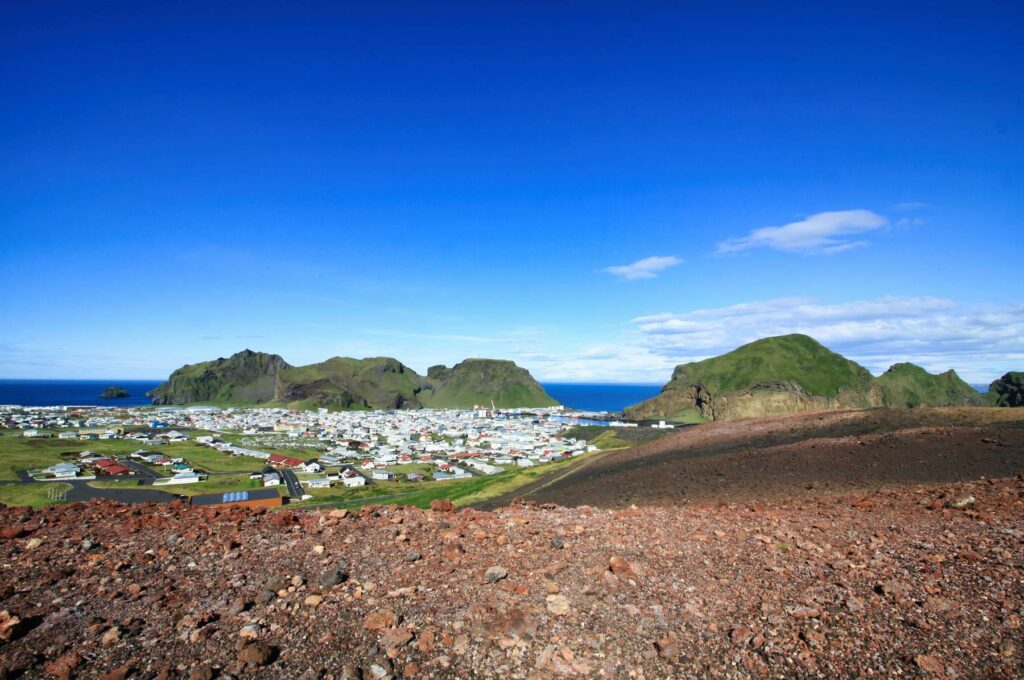
As the ferry enters the harbour, the island closes around you. Green cliffs rise straight from the water, streaked with seabirds. On one side stands Heimaklettur, the great rock that guards the bay. On the other, a reddish volcanic cone and a wide field of dark lava that runs right up to the houses.
That lava tells the story of the island.
The night of 23 January 1973
In the early hours of a winter night in 1973, the ground opened just east of the town. A fissure split the island, fountains of lava rose into the dark, and a new volcano began to grow on the edge of the houses. It would later be named Eldfell, the mountain of fire.
By chance, the fishing fleet was in port that night because of a storm the day before. Within hours, almost the entire population of around five thousand people was carried to the mainland by boat. The eruption lasted about five months. Hundreds of homes disappeared under lava and ash, and the lava flow threatened to close the harbour, the lifeline of the island.
What happened next is one of the great stories of Iceland. Islanders and rescue teams pumped seawater onto the advancing lava for weeks, cooling its front and slowing its progress. The harbour survived. When the eruption ended, the people came home, dug their town out of the ash, and rebuilt. The island was even a little larger than before.
Eldheimar, the Pompeii of the North
The best place to understand that night is Eldheimar, a museum built around a family house excavated from the ash. You walk around the half buried home, its walls still bent by the weight of the eruption, while an audio guide tells the story in the words of those who lived it. It also covers the birth of Surtsey, the island that rose from the sea just south of Heimaey in 1963 and is now a UNESCO World Heritage Site. Plan an hour at least. It is a quiet, moving place.
Walking on a young volcano
From the town, a path climbs Eldfell itself. The ground is still warm in places, and the view from the crater rim takes in the whole archipelago, the town below and, on a clear day, the mainland coast with Eyjafjallajökull rising behind it. Somewhere at the foot of those mountains, a small dark speck in a wide green plain, are the lodges you left that morning.
What to See on Heimaey
Stórhöfði and the edge of the Atlantic
At the southern tip of the island, the Stórhöfði headland is said to be one of the windiest places in Europe. A lighthouse has stood here since 1906. Standing at the edge, with the ocean opening in front of you all the way to the horizon, you understand why the islanders have always lived with their eyes on the weather.
Puffins, from spring to late summer
The Westman Islands host one of the largest puffin colonies in the world. From late spring until August, the cliffs fill with them, and Stórhöfði is one of the best places to watch them. In late summer, local children famously rescue the young pufflings that land in town, drawn by the lights, and release them back to the sea.
Heimaklettur and the harbour
For confident hikers, the climb up Heimaklettur, helped by ropes, chains and ladders, rewards you with a 360 degree view over the archipelago. Only attempt it in dry, calm weather. For everyone else, the harbour itself is a pleasure: fishing boats, the smell of salt and diesel, the sound of gulls and, often, a local showing visitors sprangan, the old art of swinging on ropes along the cliffs to collect seabird eggs.
Elephant Rock, a giant carved by the sea
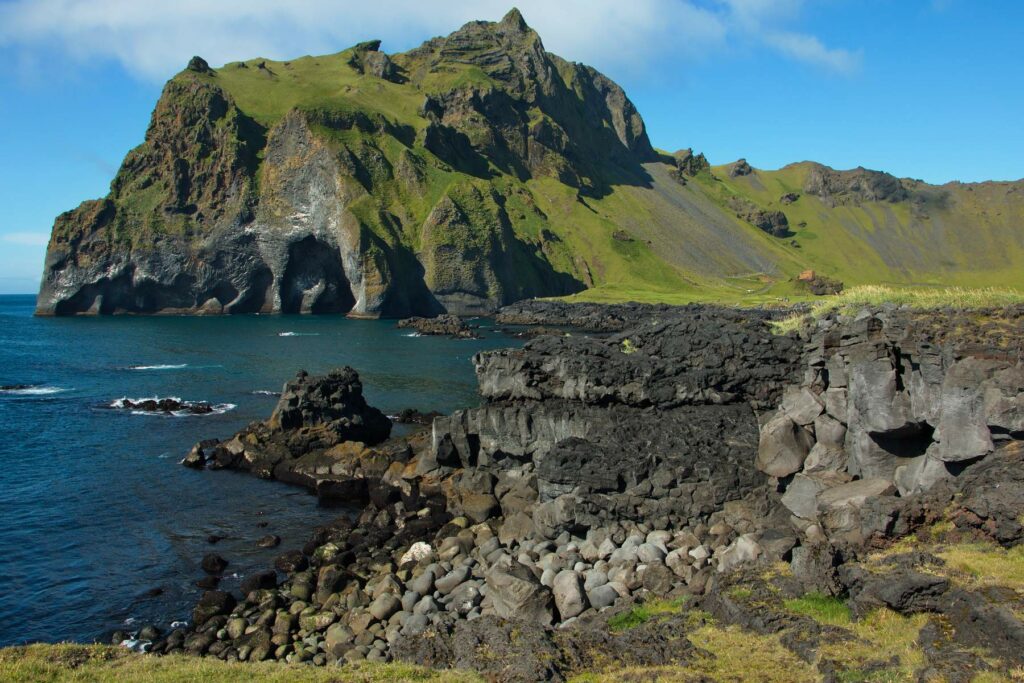
On the western cliffs of Heimaey, the ocean has sculpted something no one expects: an elephant. A huge head of dark basalt, a wrinkled grey brow and a long trunk plunging straight into the Atlantic. The resemblance is so striking that it is hard to believe it is natural, yet it is simply old lava, cooled and slowly shaped by centuries of waves and wind. Moss and lichen even give its skin the texture of a real elephant.
You do not need a boat to meet it. From the rocky lava shoreline on the west side of the island, a short walk from town, the elephant appears in full profile across the water, trunk in the sea. It is one of the most photographed views on Heimaey. In summer, the boat tours around the island also slow down in front of it. Go in the soft light of morning or late afternoon, when the texture of the rock comes alive.
Elliðaey, the loneliest house in the world
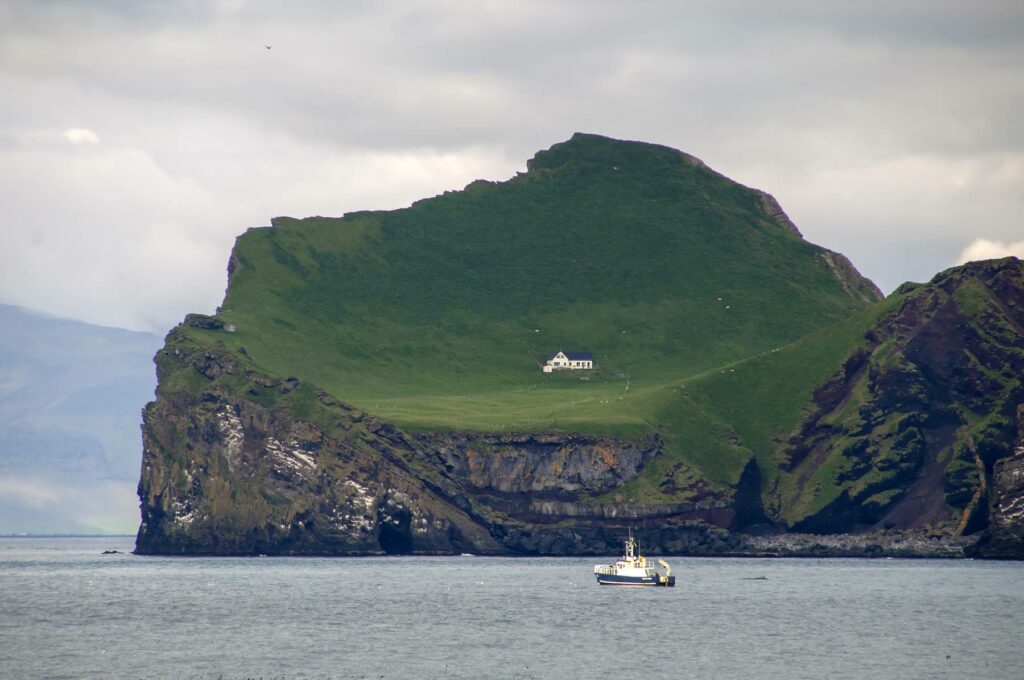
You have probably seen it without knowing its name: a small white house standing alone on a green, cliff ringed island, with nothing around it but grass, sky and ocean. The picture has travelled all over the internet as “the loneliest house in the world”.
It sits on Elliðaey, one of the islands just northeast of Heimaey. A handful of families once farmed there, but the island was abandoned during the twentieth century. The house itself was built in 1953 by the local hunting association as a lodge for the islanders who came to catch puffins in summer, as generations had done before them.
Its fame has produced many legends. It was never Björk’s home: the singer was once offered a different island of the same name, far away in the west of Iceland. Nor is it a billionaire’s hideaway built for the end of the world. The truth is simpler and, in a way, more beautiful: a modest shelter for a few days of hunting, wind and seabirds each year.
Can you go there? Not easily, and that is part of its magic. There is no harbour, no scheduled boat and no public accommodation: the lodge still belongs to the hunting association. Landing is only possible on a private charter from Heimaey, with permission and on a very calm day, scrambling ashore onto the rocks. For most travellers, the best way to see the house is from the water, on one of the boat tours that circle the archipelago in summer. Watching it pass slowly by, tiny against its green cliffs, you understand why this one image has made so many people dream of Iceland.
The beluga sanctuary
In the bay of Klettsvík, the Sea Life Trust runs the world’s first open water sanctuary for beluga whales, along with a small puffin rescue centre. Opening hours vary a lot through the year and are reduced in winter, so check before you go.
The Westman Islands in Winter
Most guides describe the islands in summer, green and loud with birds. Winter is a different island altogether, and for some travellers a more beautiful one.
The light is low and golden all day long. The streets are quiet. Snow settles on the lava field and on the slopes of Eldfell, and the contrast between black rock, white snow and dark ocean is pure Iceland. Waves break high against the cliffs, and on a stormy day the spray reaches impossible heights. Eldheimar takes on a particular intensity when the weather outside resembles the night of the eruption.
Winter does ask for a little flexibility. The ferry may switch to Þorlákshöfn, crossings can be rough, and some seasonal activities close. Keep the trip for a day with a calm forecast, stay ready to change plans, and you will have the islands almost to yourself.
A Perfect Day Trip From Your Luxury Lodge in Iceland
Here is how a Westman Islands day often unfolds from Harmony.
You wake early under the glass roof and watch the islands appear as the light grows. Coffee in bed, a last look to check the sea is calm. A short drive south through the farmland of Landeyjar brings you to the harbour, and soon the mainland is shrinking behind the boat while Heimaey grows ahead.
The morning is for Eldheimar and the climb up Eldfell. Lunch in town, with fish that was probably landed that morning. The afternoon for Stórhöfði, the harbour and a slow walk back along the lava. Then the late ferry, the sun dropping behind you over the ocean, the glacier ahead turning pink.
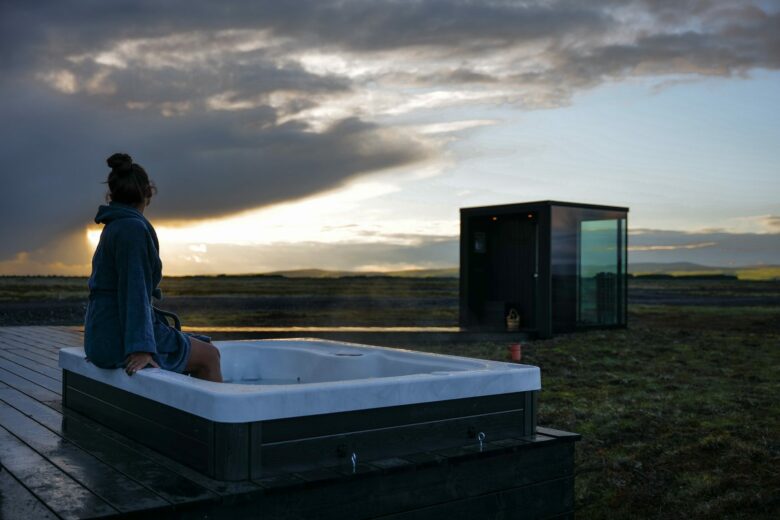
Back at the lodge, you light the private sauna. Then the hot tub, steam rising into the cold, and there they are again on the horizon: the islands you walked on a few hours ago, already turning into silhouettes. They look different now. You know what is out there.
Why the View Feels Different After You Have Been
There is a particular pleasure in a landscape you have crossed with your own feet. Before the trip, the Westman Islands are scenery, a beautiful line on the horizon. Afterwards, they become a place: a harbour with fishing boats, a warm volcano, a house half buried in ash, a family who left one night in January and came back to rebuild.
That is what Harmony was built for. Not to keep you inside, but to frame the country around you so well that you want to go out and meet it, and then to welcome you back each evening to silence, warmth and an open sky. From the glass roof to the hot tub on the deck, the lodges turn every view into an invitation: Seljalandsfoss to the west, the glacier to the north, and the islands of fire to the south.
For travellers looking for a unique stay in Iceland, it is a rare combination: a waterfall view lodge, glacier view accommodation and an ocean horizon, all from the same bed.
Plan Your Stay
To include the Westman Islands comfortably, we suggest staying at least two or three nights. Keep the island day flexible and let the forecast choose it. Use the other days for the waterfalls on your doorstep, Skógafoss, Kvernufoss and the black sand of Reynisfjara, and keep the evenings for the sauna, the hot tub and, from September to April, the Northern Lights.
Both lodges, Lilja and Georg, sleep two guests, and each has its own sauna and hot tub. The islands will be waiting on the horizon when you wake up.
Book your stay at Harmony Seljalandsfoss
Frequently Asked Questions
Yes. On clear days the islands are visible on the southern horizon from the lodges, alongside the glacier and Seljalandsfoss.
Landeyjahöfn harbour is about half an hour’s drive. The crossing to Heimaey then takes around 35 to 40 minutes.
No. Most sights are walkable from the harbour. Leaving the car at Landeyjahöfn is simpler and cheaper.
Yes, all year. In rough weather it may sail from Þorlákshöfn instead, a crossing of about two hours and forty five minutes, so check your messages from Herjólfur on the day.
From late spring until August, with Stórhöfði one of the best viewpoints.
The Eldfell volcano erupted on 23 January 1973 at the edge of town. Around 5,000 people were evacuated overnight and the eruption lasted about five months.
On the western cliffs of Heimaey. There is a viewpoint from the lava shoreline a short walk from town, and summer boat tours pass right in front of it.
It is the hunting lodge on Elliðaey, built in 1953 for puffin hunters. There is no public access or accommodation, so most visitors see it from a summer boat tour.
Sometimes. Orcas, pilot whales and minke whales are seen around the archipelago in summer, occasionally from the ferry. Sightings are never guaranteed.
Two or three nights, keeping the island day flexible for the weather.