The last thing you see before sleep is not a ceiling.
It is weather. A ribbon of cloud pulling apart over the Eyjafjallajökull glacier. A late summer sky that refuses to go fully dark. Or, on the right winter night, a slow green current moving across the black, so quiet that you hold your breath without deciding to.
Most buildings are designed to protect you from all of that. Harmony Seljalandsfoss was designed to hand it to you.
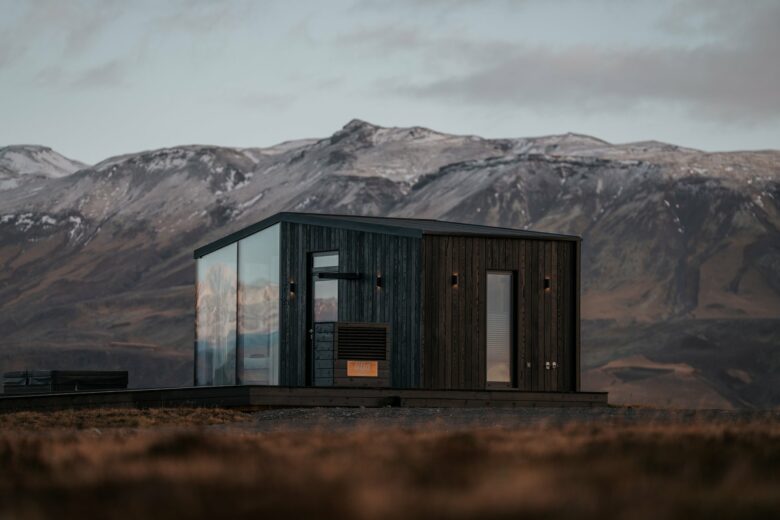
In short: Harmony Seljalandsfoss is a pair of 26 square metre glass lodges on Iceland’s South Coast, ten minutes from Seljalandsfoss waterfall. Three of the four walls are floor to ceiling glass, and so is the bedroom ceiling, so guests can watch the Northern Lights or the midnight sun from bed. Each lodge has a private sauna and hot tub.
What follows is how that building was designed, what it took to make it survive an Icelandic winter, and what it actually feels like to sleep inside it.
A Building Designed to Disappear
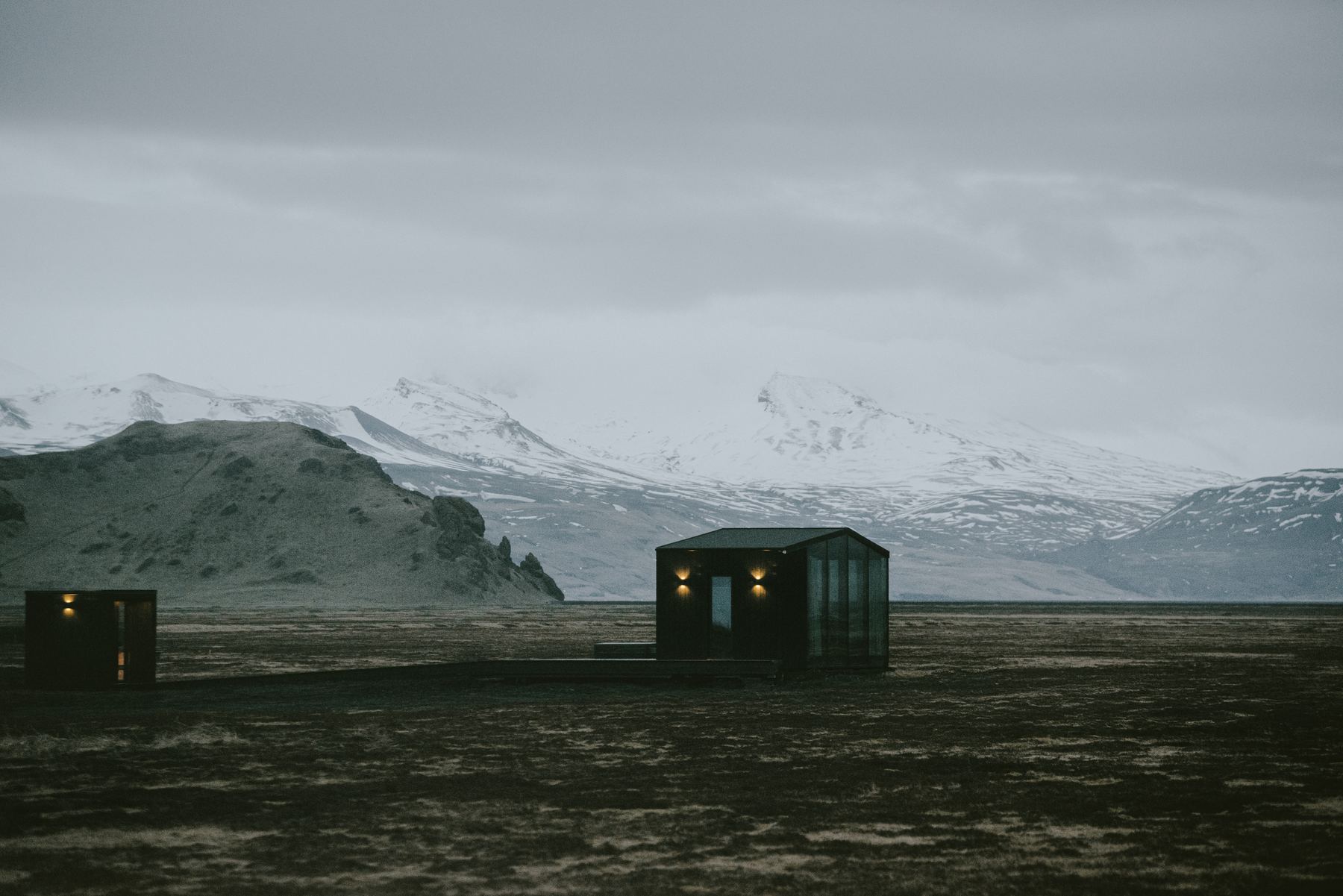
You do not see the lodges from far away. The approach is a narrow black gravel road, tussocky grass on either side, moss holding the last of the winter. There is no gate, no sign lit up against the dusk, no architectural gesture announcing that something important is about to happen.
Then the cabin is simply there.
That restraint was the first design decision, and in many ways the hardest one. Iceland’s South Coast is a landscape of enormous scale: a glacier on the horizon, a sixty metre waterfall spilling over a cliff, lava fields running to the sea. Any building that tries to compete with that loses. So this one does not try.
At 26 square metres, the footprint is deliberately modest. The single solid wall is clad in dark timber, chosen to echo the tones of the surrounding lava fields and the black sand beaches of Reynisfjara and Dyrhólaey further along the coast. From a distance, the lodge reads as a dark, low form in a dark, low landscape. It belongs to the ground it sits on rather than sitting on top of it.
Writing in T Magazine in February 2026, the New York Times described the result as a masterclass in Nordic minimalism, where the architecture works as a silent frame for the raw Icelandic wild. Frame is the right word. The building is not the subject of the picture. It is what holds the picture still.
The Glass Roof: Why It Exists
Every element of Harmony follows from one decision that was never negotiable: the bedroom would open onto the sky.
The idea came before the site, before the drawings, before any of the engineering that would eventually make it possible. Sleeping in Iceland and seeing only a ceiling felt like a waste of the country. The aurora does not arrive on schedule. The midnight sun does not wait for you to go outside and look. Both happen above you, and a roof is the thing standing in the way.
So the roof came off, in glass.
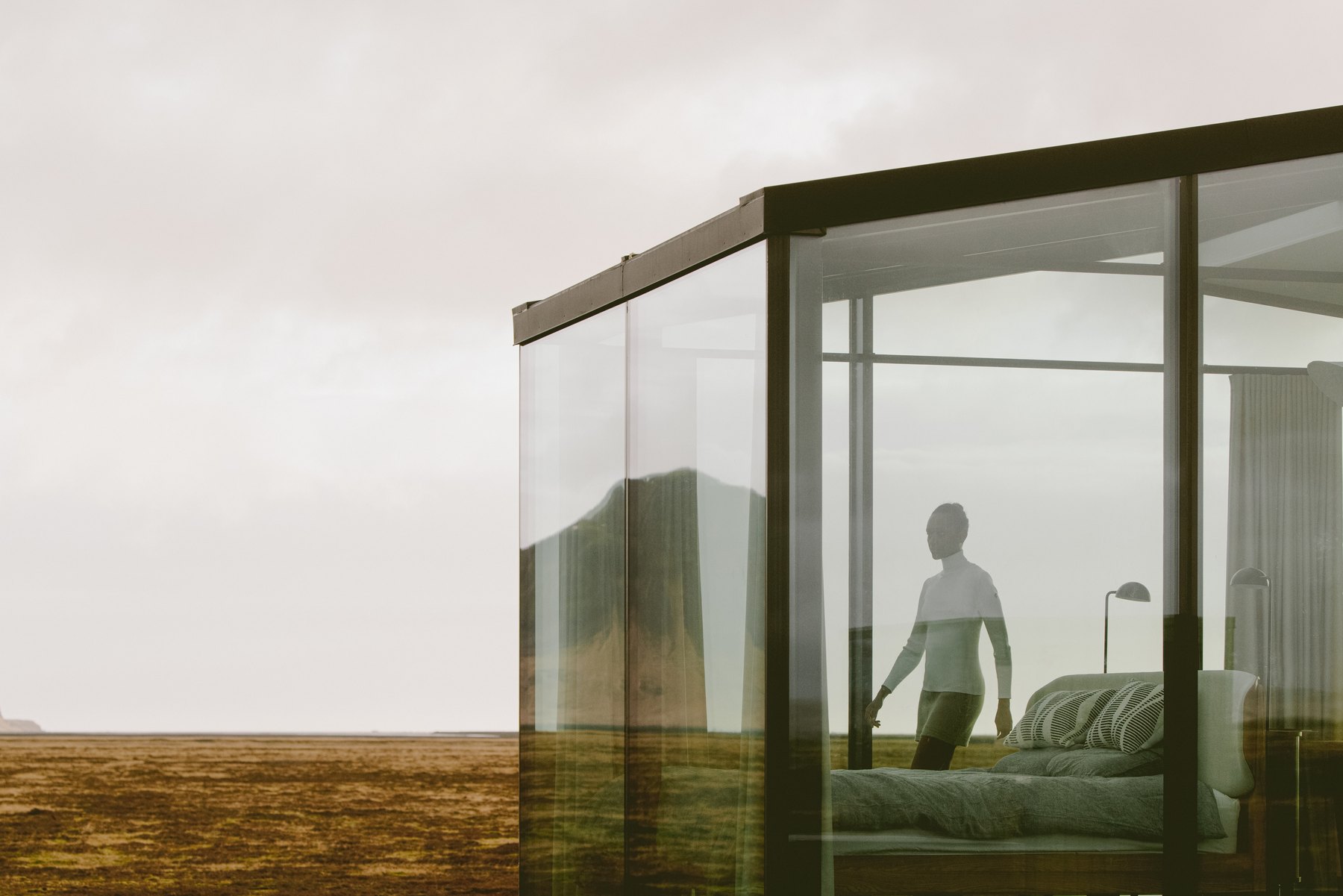
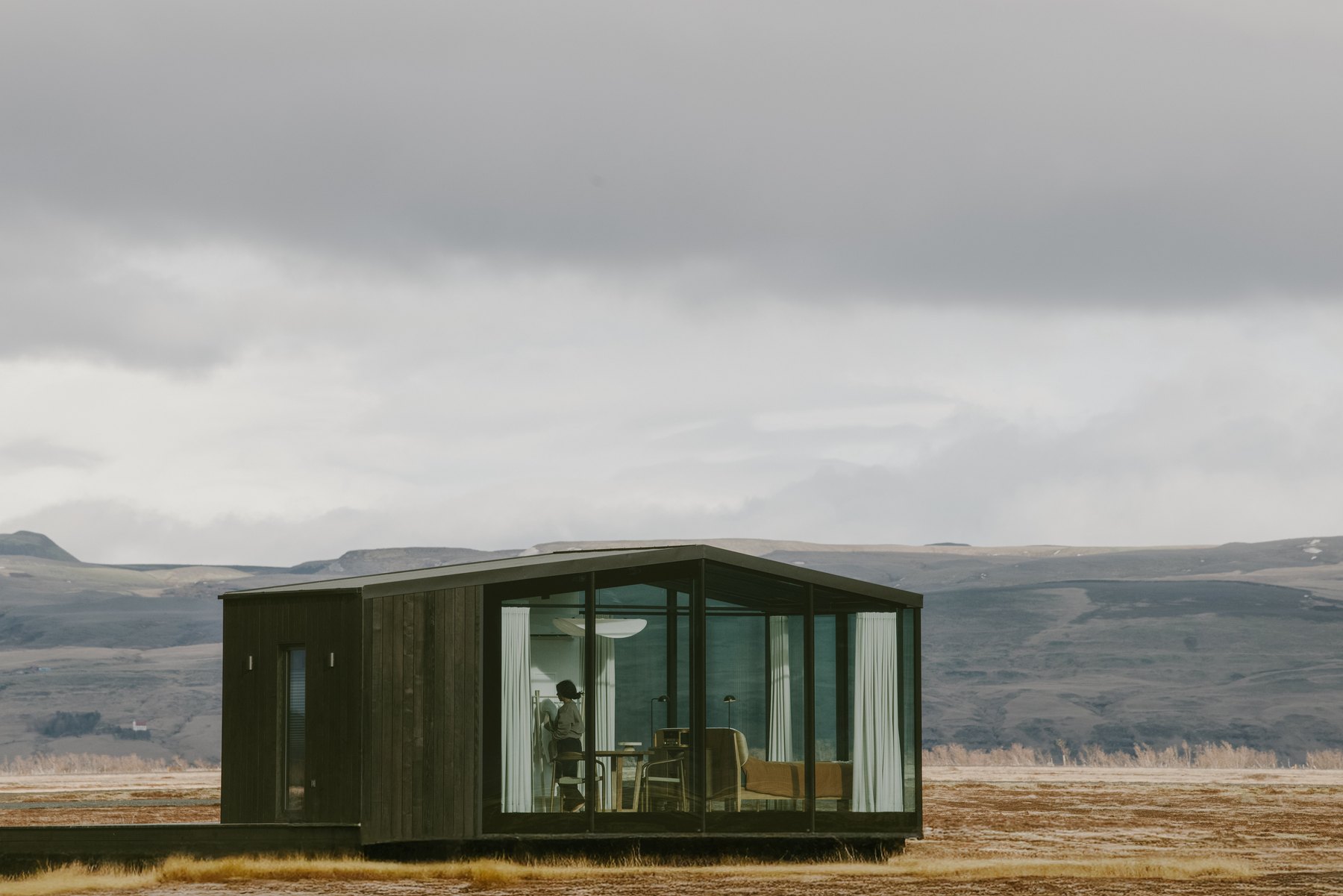
The project was developed in collaboration with Studio Bloom Paris, who took that vision and gave it a form: the proportions, the materials, the exact way light enters and moves through a small space over the course of an Icelandic day. The result is a building where the glass is not a feature added to a cabin. The glass is the cabin, and everything else exists to make it habitable.
Can you see the Northern Lights from bed?
Yes. The bedroom ceiling is glass and is deliberately left uncovered, with blackout blinds fitted only to the side windows. On a clear night during aurora season, which runs from September to April, the Northern Lights are visible directly overhead from the pillow, with no need to get dressed or go outside.
What is it like to sleep under a glass roof in summer?
In June and July the light never fully leaves. The sun grazes the horizon and comes back up, and the lodge fills with a long gold that lasts most of the night. Blackout blinds and a sleeping mask are provided for anyone who wants them. Plenty of guests use neither.
Waking up inside the weather
The consequence of that decision is that the weather is no longer something happening outside. It is the room.
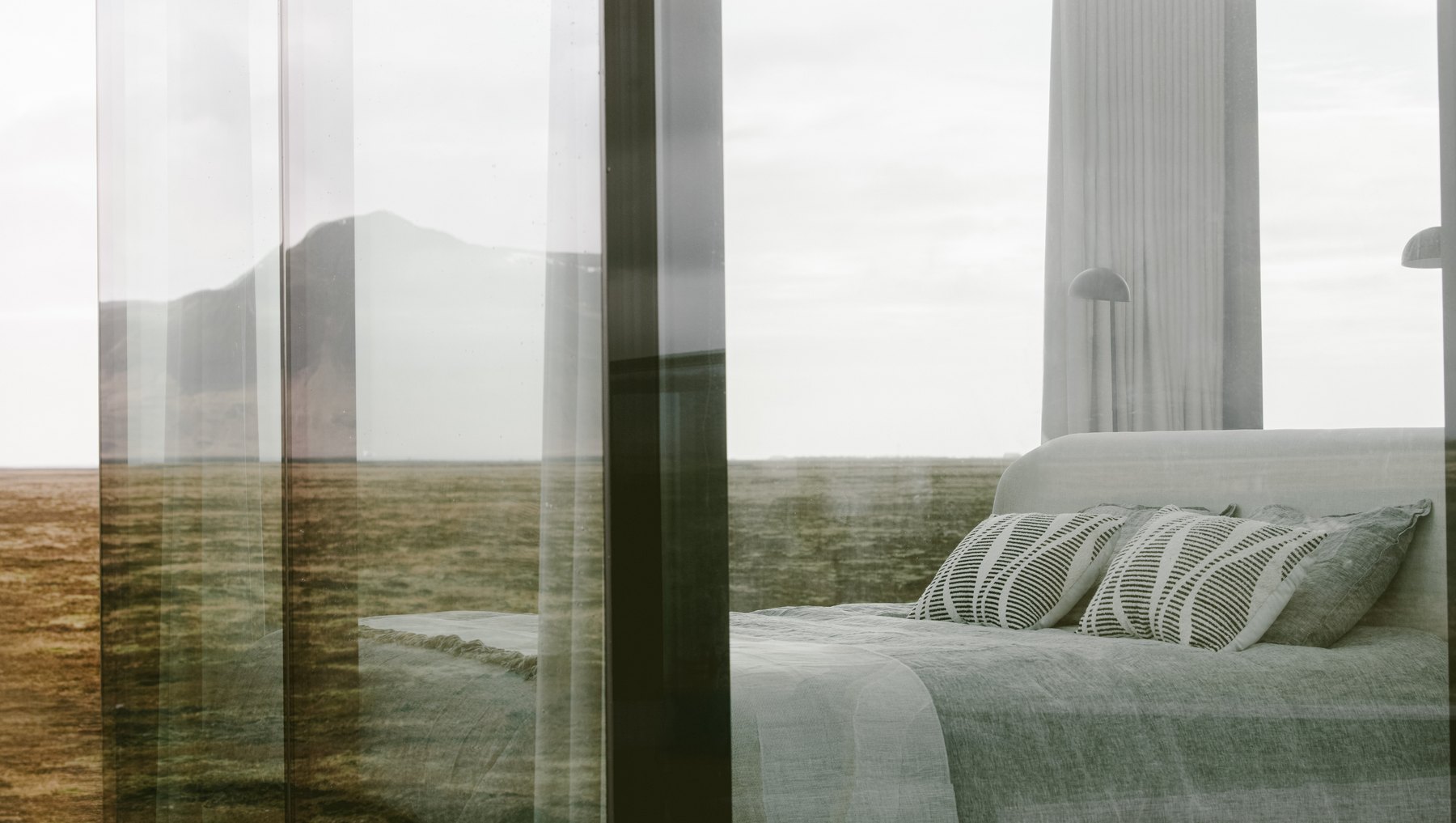
Rain arrives first as a tapping on the glass above the bed, then turns to sleet, then hail, then snow, then back to sleet again, sometimes within a single hour. The wind crosses the open tundra with nothing to slow it down and hits the glass walls with a sound you feel as much as hear. You are entirely warm, entirely dry, and entirely inside it.
Guests often arrive hoping for the postcard: still air, clear sky, green light overhead. Many of them leave saying the storm was the better night. Reviewing a spring stay for Luxury Travel Magazine in August 2026, writer Kellie Floyd described arriving hoping for the aurora, getting a storm instead, and finding the wilder version of the night the richer experience.
There is something in being held safely at the centre of that much movement that resets a person faster than calm ever does.
Steel, Timber and Glass: How a Glass House Survives an Icelandic Winter
A glass house on exposed Icelandic tundra sounds romantic until you consider what the site does in February.
Is a glass lodge warm enough in winter?
Yes. The lodges use a steel structure combined with timber elements, carrying high performance insulated glazing, with underfloor heating throughout. Steel provides the strength to hold large spans of glass against North Atlantic wind loads. The heat comes from below rather than blowing across the room, so the glass stays clear and the interior stays comfortable at sub zero temperatures.
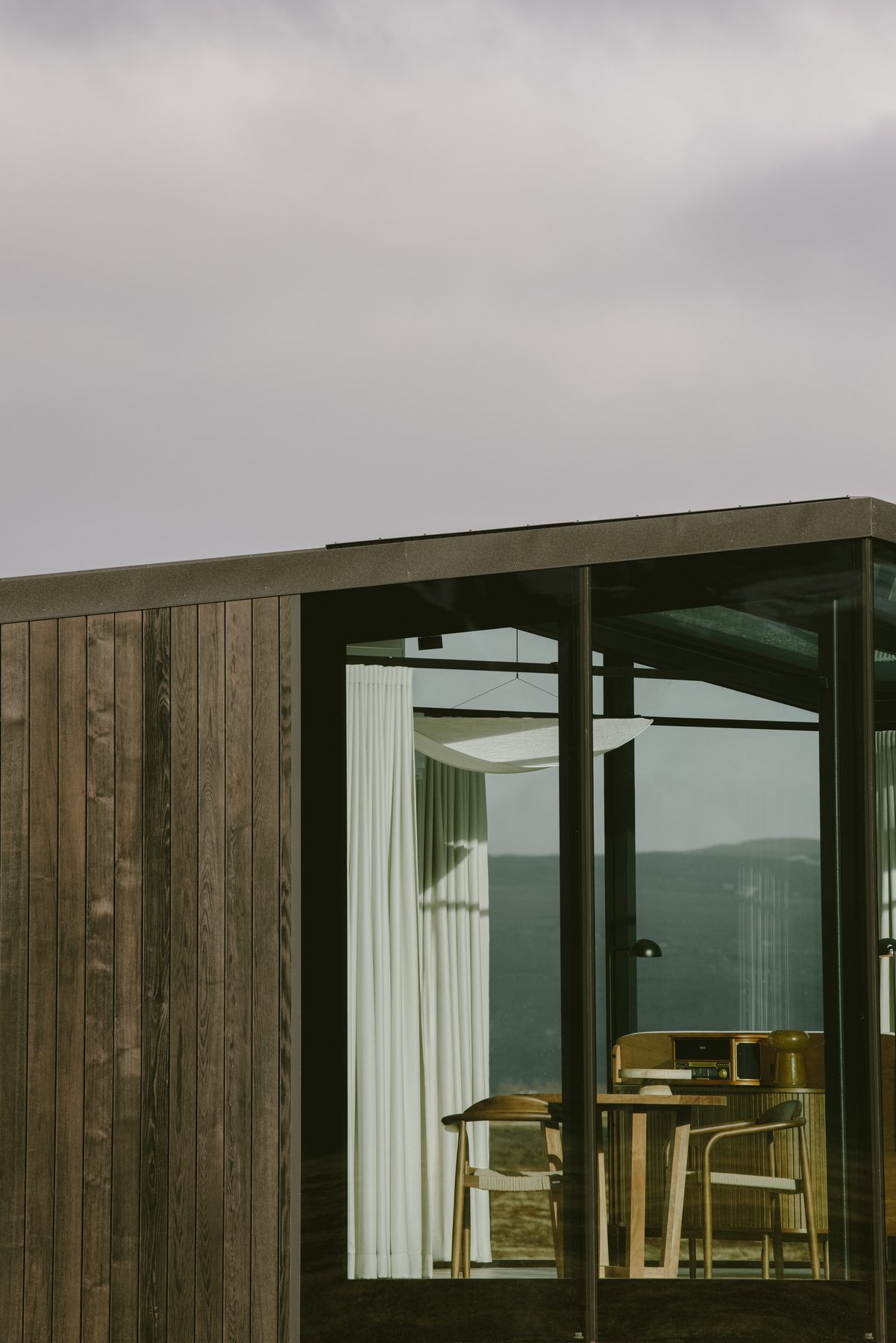
Timber softens the structure, warms it, and ties the building back to the Nordic vernacular it comes from. Every material was selected for durability in a climate that cycles between rain, freeze, salt air and storm, often in the same afternoon.
The glazing itself does the quiet work. It has to insulate hard enough that a room enclosed by glass on four surfaces stays comfortable at minus figures, while staying clear enough that the view never turns milky. You notice the underfloor heating in the small moments, standing barefoot on a warm bathroom tile while ice slides down the window beside you.
Do you need a four wheel drive to reach the lodges?
From October to March, yes. The access road is unsurfaced gravel and requires a 4WD in winter conditions. From April to September a standard two wheel drive vehicle is sufficient. Reykjavík is roughly a two hour drive northwest, and Keflavík airport around two hours and thirty minutes.
That requirement is not a design flaw. It is the honest cost of being somewhere this exposed, and most guests come precisely because of it.
The Luxury of 26 Square Metres
The instinct in luxury hospitality is more: more floor area, more furniture, more service touchpoints. Harmony argues the opposite, and the argument is made in the plan.
The king size bed sits roughly thirty centimetres from the glass on both sides and at its foot. That is not a compromise forced by a small footprint. It is the entire point. At that distance, there is effectively nothing between you and the tundra. The landscape does not sit politely beyond a window across the room. It is at the edge of the mattress.
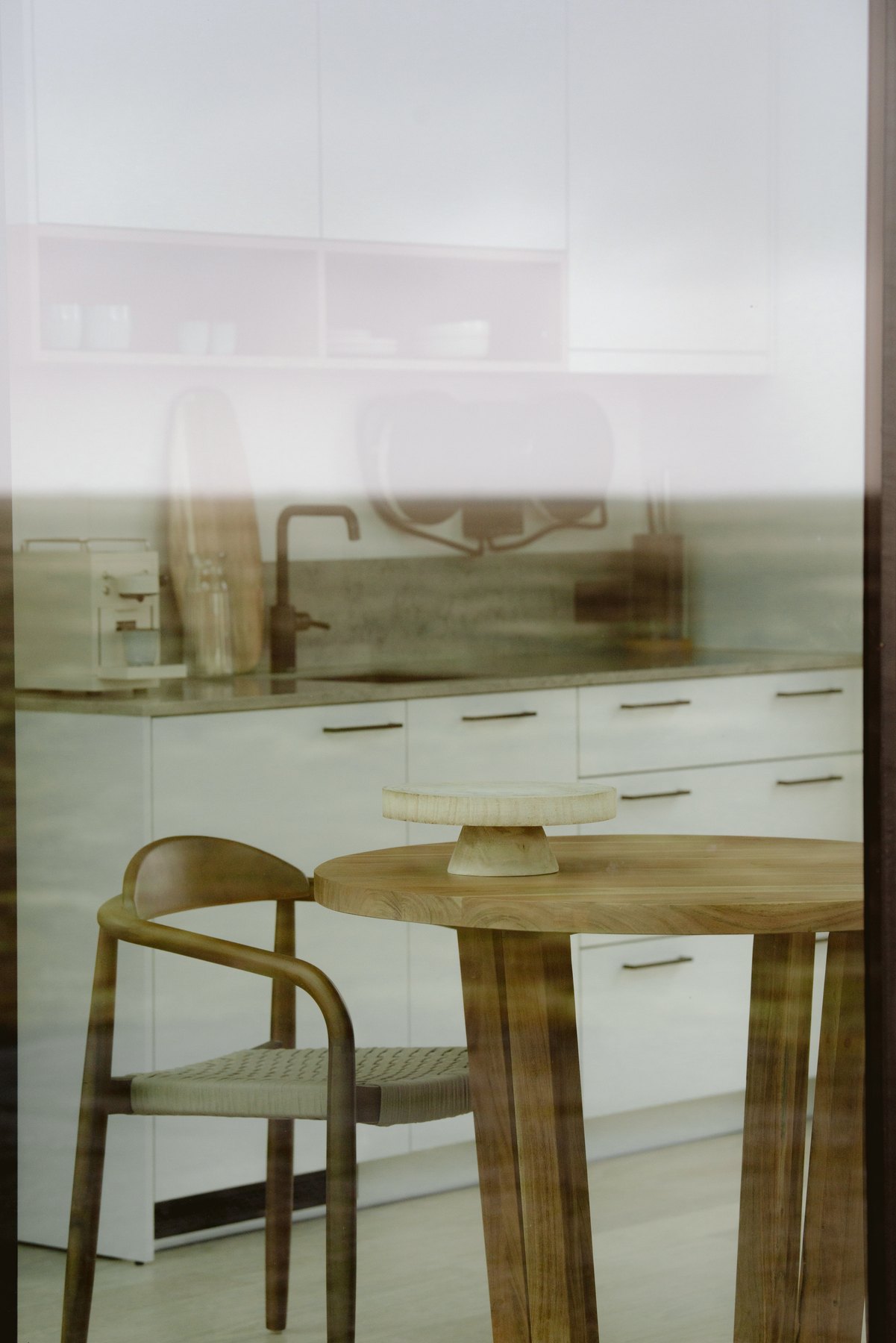
Around the bed, the programme is edited down to what is genuinely used: a compact kitchenette with an espresso machine, a handcrafted timber table for two, a bathroom with a rain shower and heated floor. Warm wood, soft neutral tones, natural textures. Clean lines that stop the eye rather than catch it.
The interior is intentionally quiet because the exterior is not. When the decoration is a glacier, anything you add competes with it.
Two objects are allowed to have personality. A sculptural light fixture gives the room a centre of warmth once the sky goes dark. And a vinyl record player sits by the bed, which is the single most reliably loved detail in the entire project. It does something no screen does: it asks you to choose one thing and stay with it for twenty minutes. In a lodge with no television and deliberately little else to do, that turns out to be exactly the right amount of ceremony.
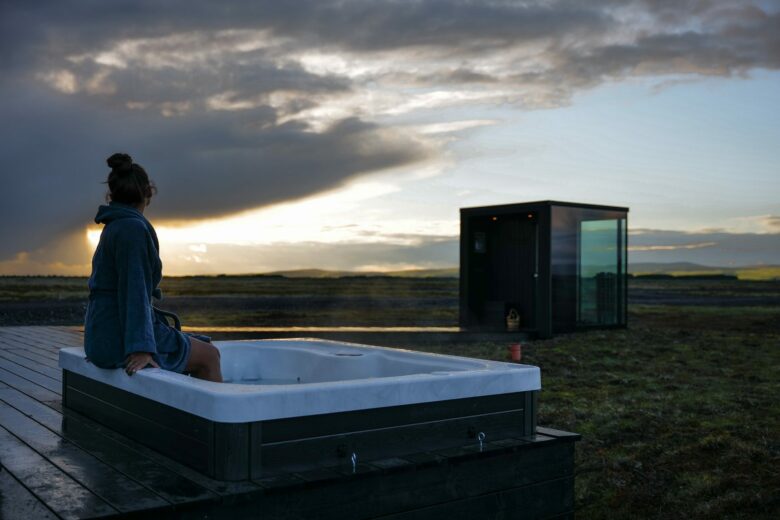
Outside, the same restraint. A dark timber deck runs out towards the hot tub and the sauna. There is no outdoor dining set, no fire pit feature, no styled corner waiting to be photographed. The deck leads you to the water and the heat, and then it gets out of the way.
Glass Again: The Sauna and the Hot Tub
The wellness elements repeat the architectural idea rather than sitting apart from it.
Each lodge has its own private sauna, glass fronted, looking out towards the Eyjafjöll mountains. You sit inside rising heat and watch a glacier that has not moved noticeably in your lifetime. It is a strange and very Icelandic kind of stillness.
A few steps away, on the deck, the outdoor hot tub. The ritual writes itself and needs no instruction: heat, then the short shock of cold air, then hot water under an open sky. In summer you do it in gold light at eleven at night. In winter you do it with snow on the deck and your breath in front of you, watching for green.
Because both are private to each lodge, there is no schedule, no shared space, no other guests. You use them at three in the morning if that is when the sky decides to perform. The full ritual, and why the order of heat and cold matters, is covered in our guide to the private sauna and hot tub.
Built With the Land in Mind
Sustainability at Harmony is less a list of certifications than a series of practical decisions made early.
Iceland generates close to 100 percent of its electricity from renewable sources, primarily hydropower and geothermal, according to the National Energy Authority of Iceland. The energy running the lodges is therefore clean before it arrives. The glazing that defines the architecture also does the environmental work: with light entering from three walls and above, artificial lighting is barely needed during the long half of the year. The drinking water at the tap comes from the glacier, pure and unprocessed, and is better than anything you would buy in a bottle. Materials were chosen for longevity in a punishing climate, because the most sustainable building is the one that does not need replacing. Waste separation is set up for every stay.
None of this is the reason people book. It is simply what it means to build seriously in a place like this: leave it capable of carrying on without you.
The Story Underneath
Buildings like this do not usually come from a business plan.
In 2015 my life was interrupted by something I had not chosen, and the years that followed were about rebuilding. In 2017 I came to Iceland for the first time. I was not looking for a project. I was looking for quiet.
What I found was a landscape that did not ask anything of me. The scale of it, the emptiness, the silence that is not an absence of sound but a presence in itself. It did more for me than almost anything else had, and I kept coming back, several times a year, staying near Seljalandsfoss until the area stopped feeling like a destination and started feeling like a place I knew.
The idea of the glass lodges grew out of that. Not as architecture first, but as a way of giving someone else the thing that had been given to me: a night where there is nothing between you and the sky, and nothing you are required to do about it. That relationship between the building and what it looks at is explored further in a waterfall at your window, a glacier on the horizon.
One of the two lodges carries my daughter’s name. Showing her what had been built here, in a place that holds her name, remains the best day of the project.
Recognition, and Why It Matters Less Than the First Night
Harmony Seljalandsfoss has been selected by the Tablet Hotels Design Awards, listed by Forbes among the best new hotel designs in Europe in March 2026, and featured by the New York Times, the Financial Times, Le Monde, Elle Decoration, Milk Decoration and Archilovers. It also appears in the MICHELIN Guide hotel selection.
That coverage matters, because it confirms that a small, quiet building in an empty field can hold its own in a conversation about contemporary architecture.
But the review that actually describes the place is the one guests say out loud at checkout, some version of the same sentence every time: I wish I could have stayed longer.
Come and Look Up
There are not many places left where you can lie in bed and watch an entire sky without a single interruption. Not a city glow, not a neighbouring building, not a ceiling.
Two lodges, The Lilja Lodge and The Georg Lodge, two guests each. A waterfall in the distance, a glacier on the horizon, a private sauna, a hot tub, and a roof made of sky.
The aurora season runs from September to April, and the long gold nights of summer sell out earliest. When you are ready to sleep under glass, the lodges are waiting.
Curious how the lodge feels when the first snow reaches the mountains? Read Iceland in October and November: The Quiet Season at Harmony Seljalandsfoss.
Frequently Asked Questions
Yes. The bedroom ceiling is glass and deliberately left uncovered, so the aurora is visible from the bed on clear nights between September and April.
Each lodge is 26 square metres and sleeps two guests. For groups of three or four, the second lodge can be booked alongside.
The project was developed by founder Djamel Cheboub in collaboration with Studio Bloom Paris, around one fixed idea: a bedroom open to the sky.
Yes. The steel and timber structure carries high performance insulated glazing, and underfloor heating keeps the lodge comfortable through the coldest months.
About ten minutes by car, and visible in the distance from the lodge itself. Reykjavik is roughly a two hour drive northwest.
From October to March, yes. The access road requires a 4WD in winter conditions. From April to September a two wheel drive vehicle is sufficient.
Each lodge has its own glass fronted sauna facing the Eyjafjoll mountains and a private outdoor hot tub on the deck. Neither is shared with other guests.
Two: The Lilja Lodge and The Georg Lodge. Each accommodates a maximum of two guests, which is why the site never feels busy.